Showing posts with label MMWR. Show all posts

Wednesday, May 22, 2019

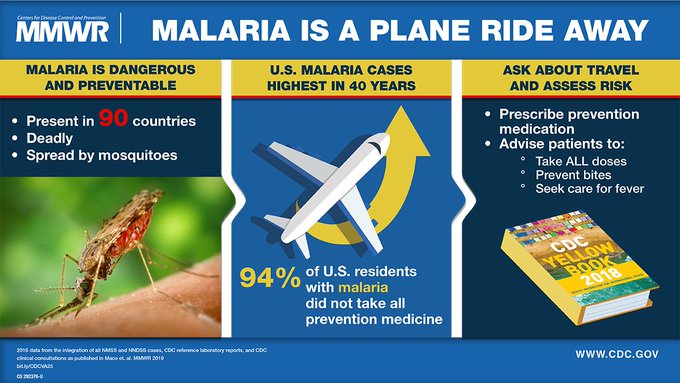
CDCMMWR Malaria Could Be Just A Plane RIde Away, Use Anti Malarial Medicine Before Traveling

Image
CDCMMWR Malaria Could Be Just A Plane RIde Away, Use Anti Malarial Medicine Before Traveling
Malaria cases are on the rise and it has now reached an all-time high in the United States. While Malaria could reach critical levels of danger, the best way to prevent malaria is to take #antimalarial medication during travel to countries where malaria is found, even if you suspect that the destination could infect you.
Even with antimalarial medicine, further protect yourself with using mosquito nets during the night and insect repellents during the day.
 
Educate yourself and the family and spend a few minutes reading the new #CDCMMWR highlights malaria trends, risk factors, and prevention. Read more: Bit.ly/CDCVA25

Monday, January 14, 2008

Overall Prevalence of Major Birth Defects Update, Atlanta, Georgia, 1978--2005

Update on Overall Prevalence of Major Birth Defects --- Atlanta, Georgia, 1978--2005

Major structural or genetic birth defects affect approximately 3% of births in the United States, are a major contributor to infant mortality (1,2), and result in billions of dollars in costs for care (3). Although the causes of most major birth defects are unknown, concerns have been raised that certain factors, such as an increase in the prevalence of diabetes among women, might result in increased prevalence of birth defects over time (4). This report updates previously published data from the Metropolitan Atlanta Congenital Defects Program (MACDP), the oldest population-based birth defects surveillance system in the United States with active case ascertainment (5). For the period 1978--2005, CDC assessed the overall prevalence of major birth defects and their frequency relative to selected maternal and infant characteristics. The MACDP results indicated that the prevalence of major birth defects in metropolitan Atlanta, Georgia, remained stable during 1978--2005 but varied by maternal age and race/ethnicity, birthweight, and gestational age. Tracking the overall prevalence of major birth defects can identify subgroups that are affected disproportionately; additional measures focused on these subgroups might improve preconception care and care during pregnancy to prevent birth defects.

The complete report could be found at CDC MMWR.


tag: , , , , , ,

Sunday, September 16, 2007

CDC Report, The first changes in suicide rates among 10-24 year olds in more than 15 years.

Release of the study, "Suicide Trends Among Youths and Young Adults Aged 10-24 Years - United States, 1990-2004," was published on seventh September in the Centers for Disease Control and Prevention's (CDC) Morbidity and Mortality Weekly Report (MMWR).

I only know too well as I helped a mother who lost a child due to suicide about three years ago, a girl.

Study results show the largest increase in youth and young adult suicide rates in 15 years. The most noted change occurred in hanging/suffocation suicides among 10-14 year old girls.

From 1990 through 2003, the total suicide rate for 10 to 24 year olds declined by 28.5 percent (9.48 to 6.78 deaths per 100,000), however, between 2003 and 2004, the overall rate of suicide climbed among this age group by 8 percent (6.78 to 7.32 deaths per 100,000), the largest single-year rise in 15 years. It is important for parents, health care professionals, and educators to recognize the warning signs of suicide in youth such as talking about taking one’s life, feeling sad or hopeless about the future. Parents should also look for changes in eating or sleeping habits and even losing the desire to take part in favorite activities.

Between 1990 and 2003, the overall suicide rate for 10-24 year olds declined by 28 percent. Between 2003 and 2004, however, the rate climbed by 8 percent, the largest single-year climb in 15 years. The rate of hanging/suffocation suicides among 10-14 year old girls more than doubled between 2003 and 2004, increasing by 119 percent. In 2004, approximately 161,000 youth and young adults between the ages of 10 and 24 received medical care for self-inflicted injuries at Emergency Departments across the United States.

LinkWithin

Related Posts Widget for Blogs by LinkWithin