Showing posts with label CDC News. Show all posts

Wednesday, May 22, 2019

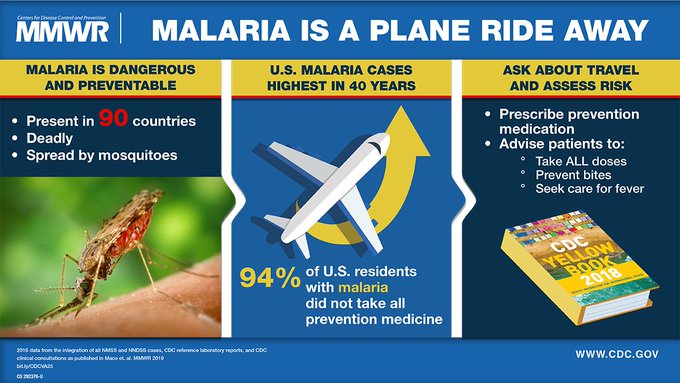
CDCMMWR Malaria Could Be Just A Plane RIde Away, Use Anti Malarial Medicine Before Traveling

Image
CDCMMWR Malaria Could Be Just A Plane RIde Away, Use Anti Malarial Medicine Before Traveling
Malaria cases are on the rise and it has now reached an all-time high in the United States. While Malaria could reach critical levels of danger, the best way to prevent malaria is to take #antimalarial medication during travel to countries where malaria is found, even if you suspect that the destination could infect you.
Even with antimalarial medicine, further protect yourself with using mosquito nets during the night and insect repellents during the day.
 
Educate yourself and the family and spend a few minutes reading the new #CDCMMWR highlights malaria trends, risk factors, and prevention. Read more: Bit.ly/CDCVA25

Wednesday, May 15, 2019

CDC is seeking public comment on updating federal guidelines used by public health agencies to assess and respond to potential cancer clusters in communities.

CDC is seeking public comment on updating federal guidelines used by public health agencies to assess and respond to potential cancer clusters in communities. The request for comment was posted today in the Federal Register and will be available for public comment through July 15, 2019.

The current guidelines, Investigating Suspected Cancer Clusters and Responding to Community Concerns: Guidelines from CDC and the Council of State and Territorial Epidemiologists (2013 Guidelines), were published in the Morbidity and Mortality Weekly Report (MMWR) in September 2013. The 2013 Guidelines are a tool to assist state, tribal, local, and territorial public health agencies in applying a systematic approach when responding to inquiries about suspected cancer clusters in residential or community settings.
Since publication of the 2013 Guidelines, there have been technical and scientific advancements that may be useful to public health agencies in responding to potential cancer clusters. CDC is working with the Agency for Toxic Substances and Disease Registry (ATSDR) to develop updated guidelines to ensure that public health agencies and stakeholders have access to current scientific tools and approaches. CDC and ATSDR will update the 2013 Guidelines based on input from subject matter experts, public health agencies, the public, and other stakeholders. We don’t know yet know how the guidelines will change. Once written, the public will have an opportunity to comment on the draft guidelines.
Interested people and organizations are invited to participate by submitting written views, information, recommendations, and data. For more information and to provide comment, please visit  https://www.federalregister.gov/documents/2019/05/15/2019-09998/updating-federal-guidelines-used-by-public-health-agencies-to-assess-and-respond-to-potential-cancer
You can also visit the CDC web site for more information on the guidelines update: https://www.cdc.gov/nceh/clusters/guidelines.htm.

Wednesday, March 13, 2019

Freezer Storage Chart To Enjoy Frozen Food Month

March is considered to be the frozen food month! Let's start it by learning about keeping food frozen and for how long. Do you know how long your food remains at best quality in the freezer? Avoid food waste by using this chart from CDC! Print, laminate and attach to your freezer door. #FrozenFoodMonth

Friday, May 27, 2011

Prevent Swimmer's Ear (Otitis Externa)This Summer!

DO keep your ears as dry as possible.
  • Use a bathing cap, ear plugs, or custom-fitted swim molds when swimming to keep water out of your ears.
DO dry your ears thoroughly after swimming or showering.
  • Use a towel to dry your ears well.
  • Tilt your head to hold each ear facing down to allow water to escape the ear canal.
  • Pull your earlobe in different directions while your ear is faced down to help water drain out.
  • If you still have water in your ears, consider using a hair dryer to move air within the ear canal.
    • Be sure the hair dryer is on the lowest heat and speed/fan setting.
    • Hold the hair dryer several inches from your ear.
DON’T put objects in your ear canal (including cotton-tip swabs, pencils, paperclips, or fingers).
DON’T try to remove ear wax. Ear wax helps protect your ear canal from infection.
  • If you think your ear canal is blocked by ear wax, consult your health care provider rather than trying to remove it yourself.
CONSULT your health care provider about using commercial, alcohol-based ear drops or a 1:1 mixture of rubbing alcohol and white vinegar after swimming.
  • Drops should not be used by persons with ear tubes, damaged ear drums, outer ear infection, or ear drainage (pus or liquid coming from the ear).
CONSULT your healthcare provider if your ears are itchy, flaky, swollen, or painful, or if you have drainage from your ears.
ASK your pool/hot tub operator if disinfectant and pH levels are checked at least twice per day—hot tubs and pools with proper disinfectant and pH levels are less likely to spread germs.
USE pool test strips to check the pool or hot tub yourself for adequate disinfectant and pH levels.
For more tips on what you can do to help prevent RWIs at your swimming facility, visit CDC’s Triple A’s of Healthy Swimming page.
For more information on ear infections, please see CDC’s Get Smart: Ear Infections page.

Friday, April 11, 2008

More Than One Million Calls 1-800-QUIT-NOW, Tobacco Cessation Program


Tobacco use is responsible for one in every five deaths in the United States each year, according to Centers for Disease Control and Prevention (CDC) data. And with more than 45 million Americans currently smoking cigarettes, tobacco use is also the leading preventable cause of death in this country.

CDC, through its Office of Smoking and Health (OSH), is the lead federal agency in a comprehensive, broad-based approach to reducing tobacco use. OSH is committed to ensuring that all people, especially those at greater risk for health disparities related to tobacco use, will achieve their optimal life span with the best possible quality of health in every stage of life.

Working with a variety of government agencies, professional and voluntary organizations, and academic institutions, OSH aims to prevent young people from starting to smoke, eliminate exposure to secondhand smoke, identify and eliminate tobacco-related health disparities and promote quitting among young people and adults.

"The single best step that a smoker can take to protect his or her health – and that of non-smoking family members — is to quit smoking," said Matthew McKenna, M.D., M.P.H., director, OSH. "Quitting smoking has immediate as well as long-term benefits, including reducing risks for cancer, heart disease, stroke, and respiratory illnesses."

Taking that first step to quitting is often difficult for smokers, but CDC, in partnership with the National Cancer Institute, the North American Quitline Consortium, and state tobacco control programs, developed the National Network of Tobacco Cessation Quitlines to provide callers free and easy access to tobacco cessation services in their state.

More than 1 million people have called 1-800-QUIT-NOW since it was established in November 2004. This telephone-based network serves as a single point of access for smokers to receive free quit coaching, a free quit plan, free educational materials, and referrals to local resources in their state.

1-800-QUIT NOW is just one of many examples of OSH's efforts to protect the public's health from the harmful effects of tobacco use.

OSH also created the National Tobacco Control Program (NTCP) in 1999 to encourage coordinated, national efforts to reduce tobacco-related diseases and deaths. The program provides funding and technical support to all 50 states, the District of Columbia, 7 U.S. territories, and 7 tribal-serving organizations. In addition, CDC funds national networks to reduce tobacco use among specific populations. CDC also provides grants to 23 states for coordinated school health programs to help prevent tobacco use.

Programs funded by NTCP are working to achieve the objectives outlined in CDC's Best Practices for Comprehensive Tobacco Control Programs—2007. This resource is an evidence-based guide to help states establish and sustain effective tobacco control programs. According to McKenna, Best Practices—2007 "identifies what works, including the investment needed to end the tobacco-use epidemic and prevent the staggering toll that tobacco takes on our families and communities."

"The tobacco-use epidemic can be stopped," said McKenna. "OSH will continue to work with policy makers, health officials, partners, and the public to ensure that tobacco control remains a core component of public health."

For more information about quitting smoking, visit http://www.cdc.gov/tobacco/quit_smoking/index.htm.

Page last reviewed: April 9, 2008
Page last updated: April 9, 2008
Content source: Centers for Disease Control and Prevention
Content owner: National Center for Health Marketing
tag: , , , , , , ,

We Need New Foodborne Illness Strategies, CDC (Centers for Disease Control and Prevention)

CDC Report Points to Need for New Foodborne Illness Strategies

A 10-state report released Thursday by the Centers for Disease Control and Prevention (CDC) showed little change in the incidence of some foodborne infections after a period of decline.

The findings are from 2007 data reported to the CDC as part of the agency′s Foodborne Diseases Active Surveillance Network, FoodNet. FoodNet monitors foodborne disease and conducts related epidemiologic studies to help health officials better understand the epidemiology of foodborne diseases in the United States. Although the FoodNet population is similar to the U.S. population, the findings are used to detect trends in foodborne illness and should not be generalized for the entire U.S. population.

Campylobacter, Listeria, Salmonella, Shigella, E.coli O157, Vibrio, and Yersinia did not decline significantly, and the estimated incidence of Cryptosporidium increased when compared with the previous three years (2004-2006). Although there have been significant declines in the incidence of some foodborne infections since surveillance began in 1996, these declines all occurred before 2004.

“The results show that prevention efforts have been partly successful, but there has been little further progress in the most recent years,” said Dr. Robert Tauxe, deputy director of CDC′s Division of Foodborne, Bacterial and Mycotic Diseases. ‘ ‘More needs to be done to make our food safer. We are constantly working to help our public health system better detect, investigate and control outbreaks and to understand how to prevent foodborne illnesses from happening in the first place. FoodNet is an important part of our food safety system and is how we measure progress.”

“FoodNet is an important public health surveillance tool,” according to Faye Feldstein, acting director of the Federal Drug Adminstration′s (FDA) Office of Food Defense. “FDA will continue to support this important endeavor and is committed to pursuing strategies to reduce all foodborne illness. FDA′s Food Protection Plan represents a major new initiative that is heavily focused on prevention linked to targeted intervention and rapid response that is taking a production to consumption approach to addressing protection of the food supply”

Consumers can reduce their risk for foodborne illness by following safe food-handling recommendations and by avoiding the consumption of unpasteurized milk, raw or undercooked oysters, raw or undercooked eggs, raw or undercooked ground beef, and undercooked poultry. The risk for foodborne illness can also be decreased by choosing in-shell pasteurized eggs, irradiated ground meat, and high pressure-treated oysters.

The full report, “Preliminary FoodNet Data on the Incidence of Infection with Pathogens Transmitted Commonly Through Food – 10 States, United States, 2007” appears in this week′s Morbidity and Mortality Weekly Report (April 11, 2008) and is available online at www.cdc.gov/mmwr. To learn more about FoodNet, please visit http://www.cdc.gov/foodnet/. To learn more about foodborne infections, visit http://www.cdc.gov/ncidod/dbmd/diseaseinfo/foodborneinfections_g.htm.

tag: , , , , , , , , , , , ,

LinkWithin

Related Posts Widget for Blogs by LinkWithin