Showing posts with label HHS. Show all posts

Thursday, June 27, 2019

Genetic Testing Scam Targets Medicare Beneficiaries.

A photo of a test tube with a DNA strand inside

Genetic Testing Scam Targets Medicare Beneficiaries.
The U.S. Department of Health and Human Services Office of Inspector General is alerting the public about a fraud scheme involving genetic testing.
Scammers are offering Medicare beneficiaries cheek swabs for genetic testing to obtain their Medicare information for identity theft or fraudulent billing purposes. Fraudsters are targeting beneficiaries through telemarketing calls, booths at public events, health fairs, and door-to-door visits.
If a beneficiary agrees to genetic testing or verifies personal or Medicare information, a testing kit is sent even if it is not ordered by a physician or medically necessary.

Protect Yourself

  • If a genetic testing kit is mailed to you, don't accept it unless it was ordered by your physician. Refuse the delivery or return it to the sender. Keep a record of the sender's name and the date you returned the items.
  • Be suspicious of anyone who offers you free genetic testing and then requests your Medicare number. If your personal information is compromised, it may be used in other fraud schemes.
  • A physician that you know and trust should approve any requests for genetic testing.
  • Medicare beneficiaries should be cautious of unsolicited requests for their Medicare numbers. If anyone other than your physician's office requests your Medicare information, do not provide it.
  • If you suspect Medicare fraud, contact the HHS OIG Hotline.

Monday, March 11, 2019

First Marburg Virus Vaccine Development Funded By HHS' BRADA, the Biomedical Advanced Research and Development Authority Funds.


HHS’ BARDA Funds Its First Marburg Virus Vaccine Development

Vaccine Could Address an Important Biodefense and Public Health Threat
To increase national health security against biothreats and protect public health, the U.S. Department of Health and Human Services (HHS) will partner with Public Health Vaccines LLC of Cambridge, Massachusetts, to develop a potential vaccine against Marburg virus. No licensed vaccine for this virus exists today.
The Marburg virus is part of the family of hemorrhagic fever viruses that includes Ebola. The virus causes a similar illness to that of Ebola, and occurs most often in Africa. The Marburg virus was recognized in 1967 and since then multiple outbreaks have occurred with high mortality rates, most recently exit disclaimer icon in 2017. In addition to the threat of naturally occurring infection, the Marburg virus, like Ebola, is deemed a potential bioterrorism threat by the U.S. Department of Homeland Security.
The Biomedical Advanced Research and Development Authority (BARDA), part of the HHS Office of the Assistant Secretary for Preparedness and Response, awarded an initial two-year, $10 million contract to Public Health Vaccines LLC to begin development of a vaccine to protect against Marburg infection.
“This vaccine candidate is the first BARDA has funded against the Marburg virus, and it is an important step toward meeting an urgent public health and biodefense need,” said BARDA Director Rick Bright, Ph.D. “We will leverage our experience in establishing public-private partnerships that bring results that are critical to saving lives and protecting Americans – and possibly people across the globe – from health security threats."
The Public Health Agency of Canada initially developed the vaccine and licensed it to Public Health Vaccines LLC. This approach is similar to the one Merck & Co. used to develop its Ebola vaccine. Under the agreement with BARDA, Public Health Vaccines LLC will conduct preclinical development to demonstrate the proof of concept that the vaccine can protect against Marburg virus.
If that initial development succeeds, BARDA has the option to provide additional funding for a total of up to $72 million to advance the Marburg virus vaccine through a Phase 2 clinical trial, and begin development of a vaccine candidate against the Sudan ebolavirus, a closely related virus, as well.

Thursday, February 21, 2019

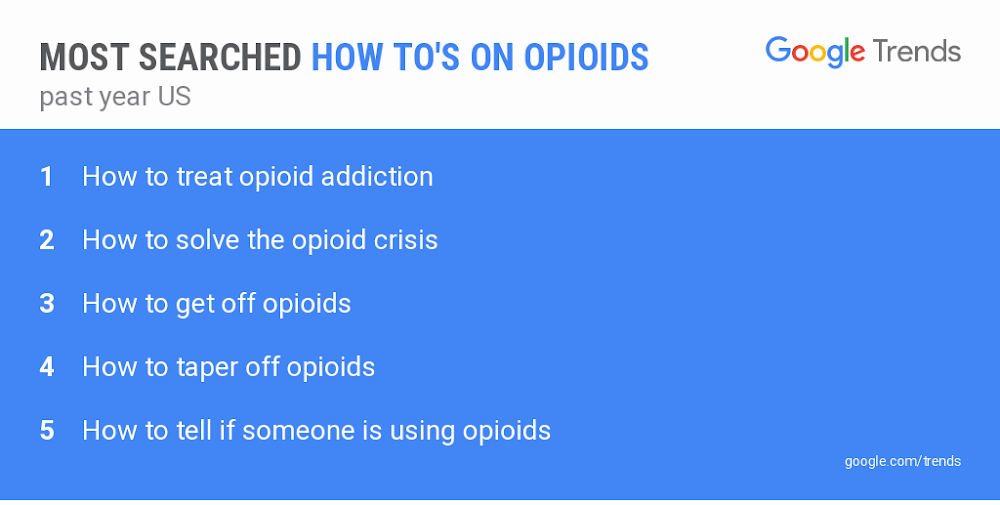
Google, DEA, Health and Human Services Join Together To Help Fight The Opioid Crisis.


opioids_data

Google has joined with Health and Human Services (HHS) to help with the the opioid crisis which is taking lives of over 130 Americans a day. This public health emergency, enveloping us with a dark cloud called opioid-related drug overdoses.
Lately Google has noticed that search queries for “medication disposal near me” reached an all-time high on Google search.

It is known that about  53% of prescription drug abuse starts with drugs obtained from the household or friends. Google is working with government agencies and nonprofit organizations to help people safely remove excess or unused opioids from their bathroom medicine cabinets.

    Today, we’re making it easier for Americans to quickly find disposal locations on Google Maps and Search all year round. A search for queries like “drug drop off near me” or “medication disposal near me” will display permanent disposal locations at your local pharmacy, hospital or government building so you can quickly and safely discard your unneeded medication..

 Read more at Google

Monday, January 31, 2011

2010 Dietary Guidelines For Americans, Joint USDA and HHS Effort To Keep Americans Healthy.

USDA and HHS Announce New Dietary Guidelines to Help Americans Make Healthier Food Choices and Confront Obesity Epidemic

WASHINGTON, Jan. 31, 2011 — Agriculture Secretary TomVilsack and Secretary of the Department of Health and Human Services (HHS) Kathleen Sebelius today announced the release of the 2010 Dietary Guidelines for Americans, the federal government's evidence-based nutritional guidance to promote health, reduce the risk of chronic diseases, and reduce the prevalence of overweight and obesity through improved nutrition and physical activity.
Because more than one-third of children and more than two-thirds of adults in the United States are overweight or obese, the 7th edition of Dietary Guidelines for Americans places stronger emphasis on reducing calorie consumption and increasing physical activity.
“The 2010 Dietary Guidelines are being released at a time when the majority of adults and one in three children is overweight or obese and this is a crisis that we can no longer ignore,” said Secretary Vilsack.  “These new and improved dietary recommendations give individuals the information to make thoughtful choices of healthier foods in the right portions and to complement those choices with physical activity.  The bottom line is that most Americans need to trim our waistlines to reduce the risk of developing diet-related chronic disease. Improving our eating habits is not only good for every individual and family, but also for our country.”
The new 2010 Dietary Guidelines for Americans focus on balancing calories with physical activity, and encourage Americans to consume more healthy foods like vegetables, fruits, whole grains, fat-free and low-fat dairy products, and seafood, and to consume less sodium, saturated and trans fats, added sugars, and refined grains.
“Helping Americans incorporate these guidelines into their everyday lives is important to improving the overall health of the American people,” said HHS Secretary Sebelius. “The new Dietary Guidelines provide concrete action steps to help people live healthier, more physically active and longer lives.”
The 2010 Dietary Guidelines for Americans include 23 Key Recommendations for the general population and six additional Key Recommendations for specific population groups, such as women who are pregnant. Key Recommendations are the most important messages within the Guidelines in terms of their implications for improving public health.  The recommendations are intended as an integrated set of advice to achieve an overall healthy eating pattern.  To get the full benefit, all Americans should carry out the Dietary Guidelines recommendations in their entirety.
More consumer-friendly advice and tools, including a next generation Food Pyramid, will be released by USDA and HHS in the coming months. Below is a preview of some of the tips that will be provided to help consumers translate the Dietary Guidelines into their everyday lives:
  • Enjoy your food, but eat less.
  • Avoid oversized portions.
  • Make half your plate fruits and vegetables.
  • Switch to fat-free or low-fat (1%) milk.
  • Compare sodium in foods like soup, bread, and frozen meals – and choose the foods with lower numbers.
  • Drink water instead of sugary drinks.
This edition of the Dietary Guidelines comes at a critical juncture for America’s health and prosperity.   By adopting the recommendations in the Dietary Guidelines, Americans can live healthier lives and contribute to a lowering of health-care costs, helping to strengthen America’s long-term economic competitiveness and overall productivity.
USDA and HHS have conducted this latest review of the scientific literature, and have developed and issued the 7thedition of the Dietary Guidelines for Americans in a joint effort that is mandated by Congress. The Guidelines form the basis of nutrition education programs, Federal nutrition assistance programs such as school meals programs and Meals on Wheels programs for seniors, and dietary advice provided by health professionals.
The Dietary Guidelines, based on the most sound scientific information, provide authoritative advice for people 2 years and older about how proper dietary habits can promote health and reduce risk for major chronic diseases.
The Dietary Guidelines aid policymakers in designing and implementing nutrition-related programs. They also provide education and health professionals, such as nutritionists, dietitians, and health educators with a compilation of the latest science-based recommendations. A table with key consumer behaviors and potential strategies for professionals to use in implementing the Dietary Guidelines is included in the appendix.
The 2010 Dietary Guidelines is available at www.dietaryguidelines.gov.
For more information on dietary guidelines, see www.health.gov/dietaryguidelines  andwww.healthfinder.gov/prevention

Thursday, April 02, 2009

American Academy of Professional Coders, Gets Ready For ICD-10 Implementation Plan

April 1st, 2009

Plan includes preparation, training and implementation guidance for payers and providers

In response to the Department of Health and Human Services’ (HHS’) final rule on the Oct. 1, 2013 implementation date for the new ICD-10-CM code system, the American Academy of Professional Coders (AAPC, www.aapc.com) announces a comprehensive, five-year ICD-10-CM training plan. The plan, which launches in September, is designed to guide providers, payers and coders through the implementation process step by step.

“Our comprehensive ICD-10 implementation plan is designed with the right approach and the right curriculum, coupled with the right timing for the trainings,” said Reed Pew, CEO and president of the AAPC. “The goal of this training program is to enable coders, administrators and others—whether in the provider or payer environment—to be well prepared and make such a clean transition that there is no interruption in payment flows.”

The plan is broken down by year (2009 – 2013) and includes a variety of delivery methods, such as Webinars, audio conferences, onsite training and national and regional conferences. A team of leading coding and ICD-10 experts developed the plan, which is broken into benchmarked steps.

As part of the implementation plan, the AAPC will provide its members with a “Personal Progress Tracker,” which gives members the ability to easily enter in personal progress with red, yellow and green lights that indicate whether the member is on schedule or not. More information, including the detailed plan and training program, is available on the AAPC’s Web site at http://www.aapc.com/ICD-10/training.aspx.

HHS’ final rule, announced in January, moved the implementation date from 2011 to 2013, allowing more time for training. The AAPC was instrumental in the final rule, with more than 60 percent of the comments submitted during the comment period coming from AAPC members.

Friday, April 25, 2008

National Infant Immunization Week, Protect Your Children Against Vaccine-Preventable Disease.
More Than Twenty Percent of Children Not Fully Protected Against Vaccine-Preventable Disease

The U. S. Department of Health and Human Services (HHS) and the Centers for Disease Control and Prevention (CDC) will launch National Infant Immunization Week (NIIW) with events beginning April 19 and continuing through April 26, 2008.

Parents, caregivers and healthcare providers will be reminded during NIIW of the benefits of vaccination and the importance of routine childhood vaccination. One focus will be encouraging parents to become informed medical consumers by talking to their healthcare providers and asking them questions about vaccines.

“Immunization has been cited as one of the ten great public health achievements of the 20th century. We can now protect children from more vaccine-preventable diseases than ever before,” said Dr. Anne Schuchat, director of the National Center for Immunization and Respiratory Diseases. “More than four million children are born each year in the U.S. and each one will need to be vaccinated. We prevent millions of cases of disease and thousands of deaths when we vaccinate them.”

There are now vaccines to protect children against 15 diseases before age two. Despite recent gains in infant immunization coverage, more than 20 percent of the nation’s two-year-olds are not fully immunized against infectious diseases to which they are especially vulnerable.

“A substantial number of children in the United States still aren't adequately protected from vaccine-preventable diseases," said Dr. Schuchat. "The suffering or death of even one child from a vaccine-preventable disease is an unnecessary human tragedy. Let us renew our efforts to ensure that no child, adolescent, or adult will have to needlessly suffer from a vaccine-preventable disease."

The number of cases of most vaccine-preventable diseases and deaths is at an all time low. Vaccination programs in the United States have contributed to the elimination of many vaccine-preventable diseases and have greatly reduced the incidence of most other vaccine-preventable diseases.

“Infants are more vulnerable to many diseases than older children and adults,” said Dr. Schuchat. “Yet it’s important for adults to also be vaccinated to keep themselves healthy and to keep from spreading infections to vulnerable people, including children.

Although vaccines have drastically reduced vaccine-preventable diseases, they are still circulating in many parts of the world and the United States can see a return of these diseases if we don’t maintain high vaccine coverage levels. Diligent efforts are required to ensure our immunization programs remain strong to protect our children.

Events throughout the United States and the entire Western Hemisphere will reach out to parents, caregivers, health care providers, and communities to highlight the benefits of vaccination and the need for routine vaccinations.

Education and media events in Washington, Rhode Island, and Connecticut will kick off this year’s celebration. Hundreds of communities across the United States are also expected to participate. Events will promote vaccinations, reminding parents and other caregivers how important it is to protect babies against vaccine-preventable diseases starting at birth.

For the fifth year, NIIW takes place at the same time as Vaccination Week in the Americas, a partnership among CDC, the Pan American Health Organization (PAHO), and the United States-Mexico Border Health Commission. Border kick-off events will be in El Paso, TX and Sundland Park, NM, and in Mexico.

For more information please visit www.cdc.gov/vaccines or call 1- 800-CDC-INFO (800-232-4636).

tag: , , ,

Wednesday, February 27, 2008

HHS Provides $40 Million in Energy Assistance to Low-Income Families

HHS Secretary Mike Leavitt announced the release of $40 million to help eligible low-income families meet home energy costs. The funds, from the Low Income Home Energy Assistance Program (LIHEAP) emergency contingency fund, will provide 11 states with heating assistance for the winter months.

“Winter weather can have a devastating impact on low-income families,” Secretary Leavitt said, “With these funds, the Bush administration will help ensure that American families are warm during the coldest time of the year.”

LIHEAP helps eligible families pay for home cooling and heating in summer and winter months. Every year, more than 5 million low-income households across the country receive assistance under LIHEAP. The money released today is directed to states with 20 percent of their low-income households using fuel oil as their primary heating source. The Energy Information Administration predicts that average home heating oil expenditures this winter will exceed last year winter’s levels by 34 percent.

“Today’s announcement highlights the Bush administration’s continued commitment to protecting America’s most vulnerable citizens,” said Acting Assistant Secretary for Children and Families Daniel Schneider. “These funds will help many Americans stay warm.”

The release of $40 million brings the total amount of LIHEAP funds released to date to approximately $2.3 billion this fiscal year, including block grant allocations and the $450 million in contingency funds released to all states on Jan. 16, 2008. One-hundred and twenty one million dollars remains available for unanticipated events in the emergency contingency fund.

States receiving emergency contingency funds today include Alaska, Connecticut, Delaware, Maine, Massachusetts, New Hampshire, New Jersey, New York, Pennsylvania, Rhode Island and Vermont.

For a complete list of state allocations of the funds released today go to http://www.acf.hhs.gov/news/press/2008/liheap_allotments_40m.html

Individuals interested in applying for energy assistance should contact their local/state LIHEAP agency. For more information, go to http://www.acf.hhs.gov/programs/liheap/ or http://www.acf.hhs.gov/programs/ocs/liheap/brochure/brochure.html.


tag: , , ,

LinkWithin

Related Posts Widget for Blogs by LinkWithin