Showing posts with label Food Safety and Applied Nutrition. Show all posts

Monday, May 13, 2019

FDA Introduces a new Nutrition Facts Label designs

The FDA is helping companies comply with the new labeling by providing several new guidance documents on issues related to serving sizes, format of the label, and other technical issues. The FDA intends to issue a final guidance on declaring added sugars on single-ingredient packages of sugars, syrups and cranberry products soon.

Compare the original and the new Nutrition Facts Label designs below.

Labeling for Transparency and Clarity The Nutrition Innovation Strategy addresses the need to modernize our approach to claims consumers see on food packaging. Public health recommendations for what is considered healthy when it comes to diet have evolved. Moreover, healthy dietary patterns now focus on food groups, the type of fat rather than the total amount of fat consumed, and now address excess added sugars in the diet. In light of these changes, and following extensive public input, FDA is working on a proposed rule to redefine the term “Healthy” when used as a nutrient content claim on a food package to update the criteria for this claim, which FDA intends to publish soon. More work on claims will follow.
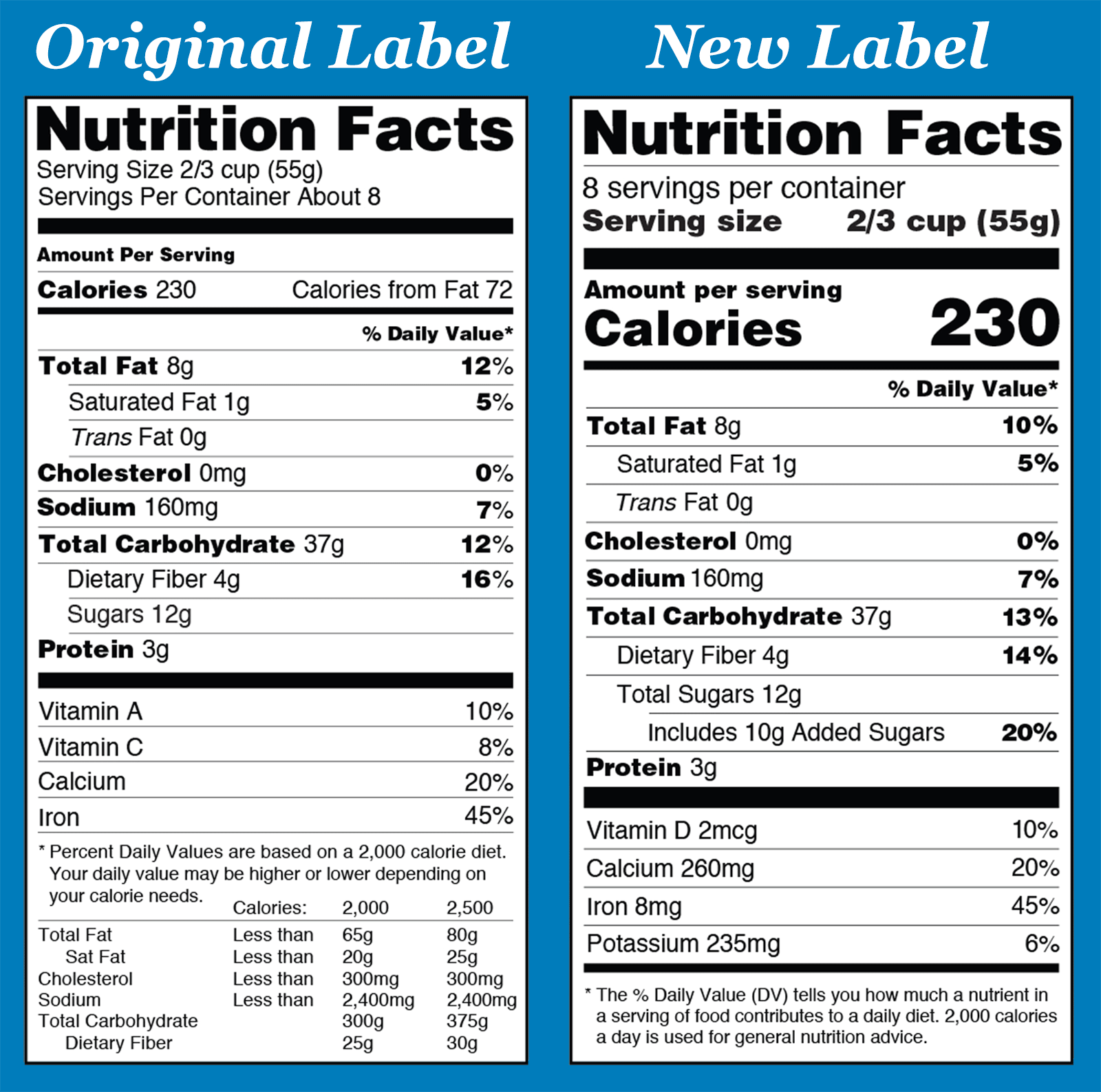
The Nutrition Facts Label: a side-by-side comparison of the original and the new designs.

Unhealthy diets are at least partly to blame for chronic diseases like heart disease, cancer and diabetes. This reality is among the reasons that nutrition has and always will be a key priority for the U.S. Food and Drug Administration (FDA). In 2018 the agency unveiled its Nutrition Innovation Strategy as a significant part of its efforts to reduce preventable death and disease related to poor nutrition. One way to achieve this is by encouraging industry innovation to create healthier products that consumers seek and helping them identify those products.


While there is still a lot of work ahead, FDA’s Center for Food Safety and Applied Nutrition and its dedicated staff are committed to empowering consumers with nutritional information to help improve their health. The FDA also strives to encourage and assist industry in making available healthier options in the marketplace - both for the short-term and in the years ahead.
FDA Susan Mayne, Ph.D., Director, Center for Food Safety and Applied Nutrition

Thursday, May 13, 2010

Evaluation of Biomarkers and Surrogate Endpoints in Chronic Disease : Report By INSTITUTE OF MEDICINE.

In 2008, the Food and Drug Administration (FDA) assigned the INSTITUTE OF MEDICINE (IOM) to conduct a study on the evaluation process for biomark­ers, focusing on biomarkers and surrogate endpoints in chronic disease.
The FDA’s Center for Food Safety and Applied Nutrition initiated this study at a time when it was faced with hundreds of applications for review of food health claims based on stated effects on biomarkers.
In the report presented by the INSTITUTE OF MEDICINE, it recommends that the FDA adopt a consistent scientific framework for biomarker evaluation in order to achieve a rigorous and transparent process. The biomarker evaluation framework should consist of three steps:
Press Release and links for obtaining the complete report.

Date:  May 12, 2010
Contacts:  Christine Stencel, Senior Media Relations Officer
Alison Burnette, Media Relations Assistant
Office of News and Public Information
202-334-2138; e-mail

for immediate release

IOM Report Recommends Framework to Evaluate Science Behind Health Claims for Foods and Drugs; Calls for Equal Rigor in Assessing Food Claims and Drug Approvals

WASHINGTON -- The U.S. Food and Drug Administration (FDA) should apply the same rigor to evaluating the science behind claims of foods' and nutritional supplements' health benefits as it devotes to assessing medication and medical technology approvals, says a new report from the Institute of Medicine.  There are no scientific grounds for using different standards of evidence when evaluating the health benefits of food ingredients and drugs given that both can have significant impacts on people's well-being, said the committee that wrote the report.  It recommended a new framework the agency can use to consistently and transparently judge the appropriateness and validity of the scientific benchmarks used in studies that companies provide to support health and safety claims for their products. 

Because it can be time-consuming and difficult to test products against actual clinical outcomes -- such as whether they cure or reduce the risk of a disease -- companies often conduct studies measuring effects on biomarkers, which are used as biological yardsticks or substitutes for clinical outcomes.  For example, tumor size is used as a way to measure a cancer drug's effectiveness.  Blood level of harmful cholesterol is often used as a biomarker for the risk of heart disease, and drug and food companies make claims about the heart health benefits of their products based on their ability to lower cholesterol levels, even if the products have not been shown to actually decrease heart disease. 

FDA has been hampered in its ability to assess the proliferation of health claims being made by food and supplement manufacturers in part because it lacks a process broadly accepted across the regulatory, food, and medical communities to evaluate biomarkers as valid and appropriate measurements to substitute for clinical outcomes.  The committee's proposed three-part framework gives the agency a way to consistently and rigorously assess the selection and use of biomarke rs across the food, device, and drug areas.    

In addition, the report calls on Congress to boost the agency's authority to require further studies of drugs and devices after they are approved if their approval is based on studies using biomarkers as surrogate clinical outcomes.  And Congress should give FDA the authority to conduct studies of how well consumers understand food and supplement health claims and require manufacturers to make changes if needed to promote greater clarity.

"Many people naturally assume that the claims made for foods and nutritional supplements have the same degree of scientific grounding as those for medications, and this committee thinks that should in fact be the case," said committee chair John Ball, executive vice president, American Society for Clinical Pathology, Chicago.  "Without changes in the way biomarkers are used and assessed, however, health care providers, regulators, and consumers will not be able to reliably collect or judge information to support claims."

The proposed framework entails validating that a biomarker can be accurately measured, ensuring that it is associated with the clinical outcome of concern, and confirming that it is appropriate for the proposed use.  Committee members demonstrated the kinds of information and lessons the framework can provide by doing several case studies, looking at tumor size as a biomarker for cancer, blood level of beta-carotene as a surrogate for cancer and cardiovascular disease risk, and cholesterol level as an indicator of heart disease, among others.

The report calls for Congress to enhance FDA's abilities to study how health-related information can be communicated more effectively to consumers to help them better understand the science behind claims they see on packaging.  The typical consumer is not aware that claims for food ingredients and supplements are often made based on studies using biomarkers instead of actual health outcomes, and that this introduces a measure of uncertainty.

FDA also needs the resources and authority to act on claims when they are found to cause confusion or to exceed regulatory limits.  A report issued by Rep. Henry Waxman's office noted that FDA enforcement of food and supplement health claims declined by more than 50 percent from 2000 to 2005.  However, recent actions by the FDA indicate it is engaging in heightened enforcement of food labeling, including health claims.

The report was sponsored by the U.S. Food and Drug Administration.  Established in 1970 under the charter of the National Academy of Sciences, the Institute of Medicine provides independent, objective, evidence-based advice to policymakers, health professionals, the private sector, and the public.  The National Academy of Sciences, National Academy of Engineering, Institute of Medicine, and National Research Council make up the National Academies.  A committee roster follows.

Copies of Evaluation of Biomarkers and Surrogate Endpoints in Chronic Disease are available from the National Academies Press; tel. 202-334-3313 or 1-800-624-6242 or on the Internet at http://www.nap.edu.  Reporters may obtain a copy from the Office of News and Public Information (contacts listed above). 

LinkWithin

Related Posts Widget for Blogs by LinkWithin